

In modern packaging and plastic manufacturing, product design is becoming increasingly diverse and complex. Brands are no longer limited to simple cylindrical or rectangular containers; instead, they demand unique shapes that enhance shelf appeal and brand identity. This raises an important question for manufacturers: Is in mold labeling suitable for complex product shapes? In mold labeling is a technology where pre-printed labels are placed inside a mold and fused with molten plastic during injection molding. It is widely used in food packaging, cosmetics, household products, and industrial containers. While it offers many advantages in durability and appearance, its compatibility with complex geometries depends on several technical and design factors that must be carefully considered.
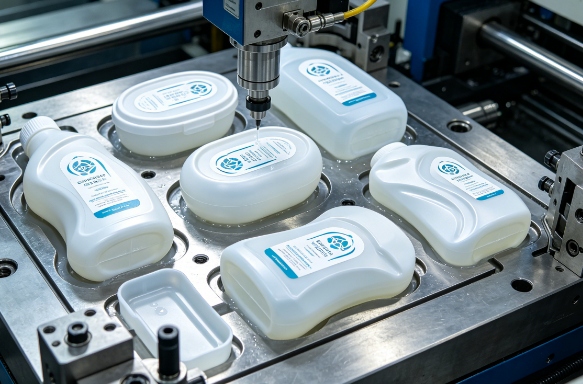
Compatibility with Curved and Irregular Surfaces
One of the key strengths of in mold labeling is its ability to adapt to a wide range of container shapes, including curved and non-standard designs. However, a successful application depends on proper mold design and label flexibility.
Important compatibility factors include:
- Flexible label films can conform to curved surfaces such as bottles, jars, and rounded containers without losing print quality.
- Proper vacuum suction inside the mold ensures that the label stays in position during injection, even on angled or uneven surfaces.
- Slightly complex shapes like tapered containers or oval bottles are commonly used in real production environments.
- Extremely sharp edges or deep undercuts may reduce label adhesion performance and require special engineering adjustments.
With the right mold structure and material selection, many complex shapes can still achieve high-quality labeling results.
Design Limitations in Highly Complex Structures
Although in mold labeling is versatile, it still has technical limitations when dealing with extremely intricate product geometries. Unlike flat labeling systems, the process requires the label to stay stable during high-pressure injection molding, which can be challenging in certain designs.
Key limitations include:
- Deep recesses or cavities may prevent the label from fully attaching to all surface areas.
- Sharp angular transitions can cause slight stretching or distortion of printed graphics.
- Extremely thin walls or uneven thickness may lead to inconsistent label fusion.
- Multi-directional undercuts are often not suitable without customized mold engineering.
Because of these limitations, manufacturers must carefully evaluate product design before selecting this labeling method for highly complex shapes.
Material Flexibility and Label Performance
Material selection plays a crucial role in determining whether complex shapes can be successfully labeled. The label must be strong enough to withstand molding pressure while remaining flexible enough to conform to the product surface.
Key material considerations include:
- Polypropylene (PP) and polyethylene (PE) are commonly used for both containers and labels due to their excellent bonding compatibility.
- Thin film labels improve flexibility, allowing better adaptation to curved or slightly irregular surfaces.
- Heat-resistant materials ensure that labels maintain integrity during high-temperature injection molding.
- Advanced coating technologies enhance print durability without affecting label flexibility.
When materials are properly matched with mold design, even moderately complex shapes can achieve stable and high-quality labeling results.
Production Efficiency and Mold Design Requirements
The suitability of in mold labeling for complex shapes also depends heavily on production engineering and mold design precision. Unlike traditional labeling methods, this process requires careful synchronization between mold structure, label positioning, and injection parameters.
- High-precision mold cavities ensure accurate label placement and prevent shifting during injection.
- Automated robotic systems are often used to insert labels consistently into complex molds.
- Vacuum or electrostatic systems help hold labels in position on vertical or angled surfaces.
- Cycle time may increase slightly for highly complex molds due to additional positioning requirements.
Although engineering complexity increases with product shape difficulty, the overall production process still benefits from automation and reduced post-processing steps.
Application Scenarios for Complex-Shaped Products
Despite certain limitations, in mold labeling is widely used in many industries that require uniquely shaped plastic products. Many commercial applications successfully combine design complexity with high-quality labeling.
Typical application scenarios include:
- Cosmetic bottles with curved, ergonomic designs that enhance user experience.
- Food containers with contoured shapes are designed for better grip and visual appeal.
- Household cleaning products featuring multi-surface labeling for brand visibility.
- Industrial containers require durable identification on non-standard surfaces.
These examples demonstrate that with proper design optimization, complex shapes can still benefit from in-mold labeling technology in real-world production.
Conclusion
Overall, in mold labeling is suitable for many complex product shapes, especially those with curved, tapered, or moderately irregular surfaces. However, its performance depends on careful coordination between mold design, material selection, and production precision. While extremely intricate or deeply undercut structures may present challenges, most modern packaging designs can successfully adopt this technology. With continued improvements in automation and material engineering, in mold labeling is becoming increasingly capable of supporting innovative and complex product designs across multiple industries.