

Hollow Injection Bar and Self-Drilling Anchor (SDA) are terms that are often encountered by engineers and procurement officers involved in tunneling, slope stabilization, and foundation reinforcement projects. Though these two terms might be occasionally confused by project managers, distinguishing between them in terms of their scope, function, and application is vital for optimal budget allocation and selection of equipment.
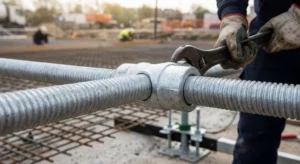
What Is a Hollow Injection Bar?
The term Hollow Injection Bar describes a steel tubular tendon with a full-length all-thread exterior. In the case of rock bolting and ground anchoring, such an element performs double duty, serving as an axial tension member and a grouting pipe.
Parameters of Structure and Production Specifications
Standard Hollow Injection Bar elements are produced from alloy seamless steel tubing with exterior threading conforming to existing international standards (ISO 10208 for rope threads – R25, R32, R38, R51; ISO 1720 for trapezoidal wave threads – T30, T40, T76, T111). The inner axial void typically accounts for 30% to 50% of the total cross-sectional area. This design is hollow to enable thick cementitious grout (water/cement ratio range 0.4-0.5) or resin chemicals to flow easily within the bar core at injection pressures ranging from 2.0 to 5.0 MPa.
Advantages of Core Functionality
Dual Channel Functionality: Can act as a grouting pipe when the anchor is installed, but acts as a permanent or temporary load-carrying tendon once the grouting process is completed.
Increase Bond Strength: Due to the presence of a continuous outer wave thread, which forms mechanical bonding with the surrounding mortar, bond strength is provided up to 2.0-4.0 MPa.
What is a Self-Drilling Anchor System?
As opposed to a single steel bar element, a Self-Drilling Anchor (SDA) system is a complete drilling-grouting-anchoring system in one unit. This method was specifically designed to solve the problem of borehole collapse in difficult geological formations such as loose sands, gravel formations, highly weathered rock, and mixed fills.
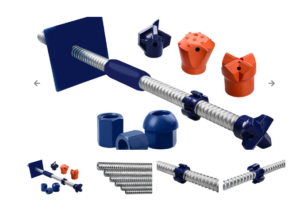
The complete self-drilling anchor system consists of the following five units:
- Sacrificial Drill Bit: Located at the head, it makes the advancement of the borehole, and it gets permanently embedded. Some choices include cross bits for soft ground and button bits for hard rock formations.
- Hollow Core Tendon: This is the main load-carrying hollow injection bar that provides rotational torque, percussive energy, and flushing fluid.
- Threaded Coupling: Allows for segmented extensions of the bar to enable anchorage deep into the formation, and has internal stop rings to prevent grout from leaking through the joints.
- Bearing Plate and Hex Nut: Located at the face of the rock, these carry tension loads to the structural facing with the help of spherical washers that take care of angular misalignment up to 5° to 7°.
What Are the Physical Differences Between a Hollow Injection Bar and an SDA?
To compare one piece with a complete ground support system, the following table gives some physical differences:
| Evaluation Criteria | Hollow Injection Bar (Tendon Component) | Self-Drilling Anchor (SDA System) |
| System Scope | Single hollow steel bar element | Integrated kit with drill bit, coupler, plate, and nut |
| Installation Sequence | Requires a pre-drilled hole (or serves as SDA core) | Drilling, grouting, and anchoring completed in one operation |
| Drill Bit Requirement | Operates independently of bit when placed in pre-drilled holes | Mandates a sacrificial drill bit permanently attached at the tip |
| Geological Suitability | Stable rock masses capable of open hole stand-up time | Collapsible, unbonded, or loose overburden formations |
| Tensile Capacity Range | Yield strength spans typically from 180 kN to 1900 kN | Governed directly by the selected Hollow Injection Bar size |
In summary, the Hollow Injection Bar is the main structural core of an SDA unit, while the SDA system is the whole drilling process without casings, based on the injection bar.
What Are the Technical Performance Criteria and Corrosion Resistance for a Hollow Injection Bar?
Resistance to corrosion of the Hollow Injection Bar in waterlogged, acidic soils, and marine environments is one of the factors that will affect the lifespan of the anchoring system as a whole.
Steel Protection Techniques
To prevent rusting in aggressive soil conditions, special surface treatment is applied:
- Hot Dip Galvanizing (HDG): The zinc coating layer with a thickness of more than 85 μm (ISO 1461 compliant) guarantees corrosion protection for more than 50 years. The galvanized Hollow Injection Bar units manufactured by ONTON company are resistant to pitting corrosion from oxygen-saturated groundwater.
- Epoxy coating: This kind of protective polymer coating with a thickness of 200-300 μm protects against a highly corrosive chemical environment.
Examples of Mechanical Properties
- R32N Specification: Outer diameter of 32 mm, inner diameter of 18.5 mm, cross-sectional area around 360 square millimeters, yield load >= 230 kN, and ultimate tensile strength >= 280 kN.
- T76N Specification: Outer diameter of 76 mm, inner diameter of 45 mm, cross-sectional area around 2230 square millimeters, yield load >= 1200 kN, and ultimate tensile strength >= 1600 kN.
How to Select the Right Configuration for Engineering Projects?
While deciding between sourcing individual bar components or sourcing complete self-drilling anchor systems, geotechnical engineers consider three basic field considerations:
Borehole Stand-Up Time
If boreholes stand up well for several days in solid granite and unweathered limestone, drilling of open holes with a regular DTH hammer and placing Hollow Injection Bar for solo grouting is possible. However, in case of collapsible soils, it is necessary to use a complete set of SDA systems with sacrificial bits.
Depth of Anchor Requirement
If the anchor lengths are more than individual bar lengths (3 meters or 4 meters, respectively), then high-strength couplers will have to be used that can transmit 100% of the forces at the connected joints.
Rotary Percussive Rig Torque
The rotary percussive drilling rigs will have to provide sufficient torque (between 2.5 and 8.0 kN·m).
Conclusion
In short, a Hollow Injection Bar and a Self-Drilling Anchor solution do not compete against each other; rather, the first is the essential element, whereas the latter is a complete solution to install the former. The former functions as a multifunctional hollow tendon for grouting and loading, whereas the latter is a solution combining that bar with sacrificial drills and hardware in order to avoid temporary casing when drilling into soft ground. Choosing between individual hollow bars and self-drilling anchors fully depends upon the conditions of the project site.