

As global communication networks continue to expand, the demand for stable and long-lasting broadband infrastructure has become increasingly important. Among the essential components of modern fiber networks, the fiber optic drop cable plays a crucial role in connecting end users to high-speed internet services. Whether used in residential FTTH deployments, commercial buildings, or outdoor installations, the lifespan of these cables directly affects network reliability and maintenance costs. However, the actual service life of a fiber optic drop cable can vary depending on environmental conditions, installation quality, material selection, and usage intensity. Understanding its typical lifespan helps network planners and users make informed decisions about long-term infrastructure investments.
Typical Lifespan of Fiber Optic Drop Cable
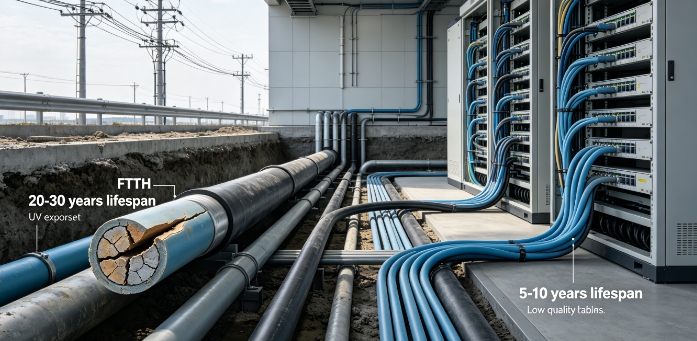
Under normal operating conditions, a fiber optic drop cable is generally designed to last between 20 and 30 years. This long lifespan makes it one of the most durable components in modern communication systems.
- Standard indoor environments: When installed indoors with stable temperature and minimal physical stress, cables can easily reach or exceed 25–30 years of service life.
- Outdoor environments: Exposure to weather conditions may slightly reduce lifespan to around 20–25 years, depending on protection quality.
- High-quality industrial-grade cables: Premium materials and reinforced structures can extend operational life even beyond standard expectations.
- Low-quality installations: Poor manufacturing or improper handling may significantly shorten the lifespan to below 15 years.
These estimates show that fiber optic drop cables are designed for long-term infrastructure use, making them a cost-effective communication solution.
Environmental Conditions and Their Impact
Environmental exposure is one of the most important factors influencing how long a fiber optic drop cable can remain functional.
- Temperature extremes: Constant exposure to high heat or freezing conditions can degrade cable jackets over time.
- Moisture and humidity: Water infiltration can damage internal fibers if waterproofing layers are insufficient.
- UV radiation exposure: Prolonged sunlight exposure may cause aging and cracking in outdoor cable sheaths.
- Physical stress from wind or vibration: Aerial installations may experience mechanical fatigue over time.
These environmental influences highlight the importance of selecting cables with strong protective designs for outdoor use.
Installation Quality and Handling Practices
Even a high-quality fiber optic drop cable may not reach its expected lifespan if installation is not performed correctly.
- Improper bending radius: Excessive bending can cause micro-fractures in optical fibers, reducing long-term performance.
- Excess pulling force during installation: Stretching the cable beyond recommended limits may weaken internal structures.
- Poor connector installation: Incorrect termination increases signal loss and may lead to early system failure.
- Lack of protective routing: Cables exposed to sharp edges or pressure points are more likely to suffer long-term damage.
Proper installation practices are essential for ensuring the cable reaches its full expected service life.
Material Quality and Structural Design
The durability of fiber optic drop cables is also significantly influenced by their internal structure and protective materials.
Outer Jacket Protection
- LSZH materials improve safety and durability in indoor environments.
- UV-resistant coatings help prevent aging in outdoor installations.
Reinforcement Components
- Steel wire or FRP elements increase tensile strength and resistance to stretching.
- Reinforced designs improve stability in aerial deployments.
Fiber Core Protection
- High-quality glass fibers reduce signal degradation over time.
- Water-blocking materials prevent moisture-related damage.
Together, these design features significantly extend cable lifespan and ensure stable performance over decades.
Maintenance and Operational Conditions
Ongoing maintenance also plays an important role in determining how long a fiber optic drop cable remains effective in real-world applications.
- Regular inspection schedules: Early detection of wear or damage helps prevent long-term failures.
- Connector cleaning and upkeep: Dust and contamination can reduce signal quality over time.
- Network load management: Overloading communication systems may increase stress on connected infrastructure.
- Timely repair of damaged sections: Small issues can expand if not addressed quickly.
Proper maintenance ensures that the cable continues operating close to its original performance level throughout its lifespan.
Conclusion
In conclusion, a fiber optic drop cable typically lasts between 20 and 30 years under normal operating conditions, making it a highly durable and reliable component of modern communication networks. Its actual service life depends on a variety of factors, including environmental exposure, installation quality, material selection, and ongoing maintenance measures. While high-quality cables installed in controlled environments can last even longer, poor handling or harsh conditions may shorten their service life. Overall, with proper design, installation, and care, fiber optic drop cables provide long-term stability and cost-effective performance for both residential and commercial network infrastructures.