

In industrial automation and robotics, robotic arms are essential tools for improving production efficiency and precision. Among the most commonly used configurations is the 5-axis robot arm, which is widely applied in manufacturing, packaging, and light industrial tasks. However, with the advancement of automation technology, the 6-axis robot arm has become increasingly popular due to its higher flexibility and more complex motion capabilities. The main difference between these two types lies in the number of joints (degrees of freedom), which directly affects their movement range, operational precision, and application scenarios. Understanding these differences helps businesses choose the most suitable robotic solution for their production needs.
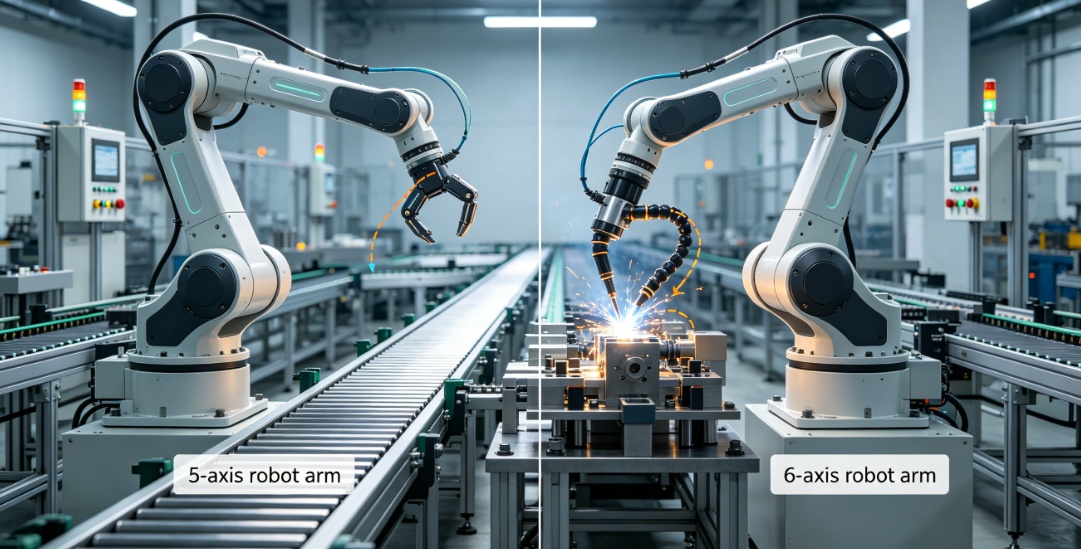
Structural Differences Between 5-axis and 6-axis Robot Arms
The most fundamental difference between a 5-axis robot arm and a 6-axis robot arm is the mechanical structure and the number of movement axes.
- 5-axis robot arm structure
A 5-axis robot arm consists of five rotational joints that allow movement in multiple directions, such as base rotation, shoulder movement, elbow bending, and wrist positioning. However, it lacks full rotational freedom at the end effector. - 6-axis robot arm structure
The 6-axis robot arm adds an extra rotational joint at the wrist, enabling complete 360-degree orientation of the tool. This allows more complex spatial positioning and manipulation. - Effect on motion range
The additional axis in the 6-axis system significantly improves flexibility, enabling it to reach positions and angles that a 5-axis robot arm cannot achieve.
Functional Capabilities in Industrial Applications
The number of axes directly influences what tasks each robotic arm can perform efficiently in industrial environments.
- 5-axis robot arm applications
A 5-axis robot arm is commonly used for pick-and-place operations, simple assembly tasks, packaging, and material handling, where orientation complexity is limited. - 6-axis robot arm applications
The 6-axis version is suitable for more advanced tasks such as welding, precision assembly, CNC machine tending, and operations requiring multi-angle positioning. - Task complexity comparison
While the 5-axis robot arm performs well in repetitive and structured tasks, the 6-axis system excels in dynamic environments requiring high flexibility and adaptability.
Motion Control and Precision Differences
Another key difference lies in how each robot arm handles movement control and precision tasks.
- 5-axis motion characteristics
The 5-axis robot arm provides stable and efficient motion but has limited ability to adjust tool orientation in complex angles, which may reduce precision in certain tasks. - 6-axis motion advantages
With an extra degree of freedom, the 6-axis robot arm can maintain precise orientation control, especially in tight or irregular workspaces. - Trajectory planning complexity
6-axis systems require more advanced motion algorithms to coordinate all joints, resulting in smoother and more human-like movement paths.
Programming, Integration, and System Flexibility
The complexity of programming and system integration also differs significantly between the two robot types.
- 5-axis robot arm programming
Programming a 5-axis robot arm is generally simpler, making it suitable for beginners and basic automation setups with limited variables. - 6-axis programming requirements
A 6-axis robot arm requires more advanced programming skills due to increased joint coordination and path optimization requirements. - Integration with smart systems
6-axis robots integrate more effectively with AI vision systems, smart factories, and flexible production lines compared to the 5-axis robot arm.
Cost, Efficiency, and Industrial Selection Factors
When choosing between a 5-axis and 6-axis system, cost and operational efficiency are important considerations.
- 5-axis robot arm cost advantage
The 5-axis robot arm is generally more affordable and easier to maintain, making it suitable for small and medium-sized enterprises. - 6-axis investment benefits
Although more expensive, 6-axis systems offer higher productivity, flexibility, and long-term efficiency in complex manufacturing environments. - Efficiency trade-off
5-axis systems are more efficient for repetitive tasks, while 6-axis robots provide better efficiency in multi-step and variable operations.
Conclusion
The main difference between a 5-axis robot arm and a 6-axis robot arm lies in their degrees of freedom, motion flexibility, and application range. A 5-axis robot arm is ideal for simple, repetitive industrial tasks with limited orientation requirements, while a 6-axis robot arm provides advanced movement capabilities for complex and high-precision operations. Although 6-axis systems require higher investment and more complex programming, they offer significantly greater flexibility and adaptability. Choosing the right robotic arm depends on production needs, task complexity, and automation goals in modern industrial environments.