

A glasses free 3d display represents one of the most advanced developments in modern visualization technology, enabling users to experience three-dimensional content without wearing special eyewear. By using optical systems such as lenticular lenses, parallax barriers, and multi-view rendering techniques, this technology delivers depth perception directly from the screen. Despite its impressive capabilities, the performance of a glasses free 3d display is still affected by several technical and environmental challenges. These limitations influence image quality, viewing stability, system cost, and overall user experience. Understanding these challenges is essential for evaluating its current performance and future development potential across industries such as entertainment, education, advertising, and professional design.
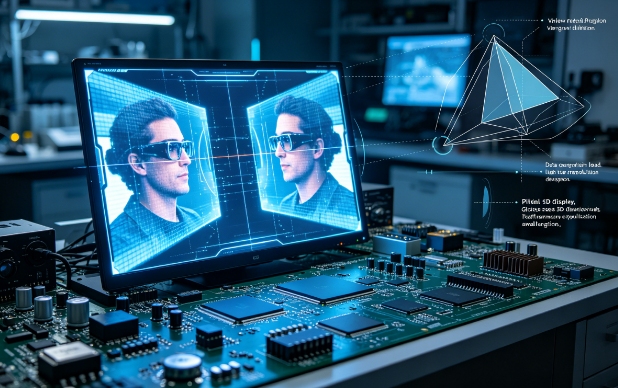
Viewing Angle Limitations and Spatial Restrictions
One of the most significant challenges affecting a glasses free 3d display is its limited optimal viewing range, which directly impacts how users experience depth perception.
- Restricted sweet spot area: The 3D effect is strongest only within specific horizontal and vertical viewing zones, making positioning critical for users.
- Image distortion outside ideal angles: When viewers move beyond the optimal range, images may appear blurred, doubled, or lose depth accuracy.
- Reduced multi-user consistency: In shared environments, different viewers may experience varying levels of 3D quality depending on their position.
- Spatial sensitivity issues: Even small head movements can sometimes affect perceived depth stability in lower-end systems.
These limitations make viewing angle control a key engineering challenge for improving glasses free 3d display performance.
High Computational Demand and Rendering Complexity
Another major challenge for a glasses free 3d display is the heavy computational workload required to generate real-time multi-view images.
- Multi-perspective rendering requirements: The system must create multiple slightly different images simultaneously to simulate depth.
- GPU processing load: High-performance graphics processing units are needed to maintain smooth playback without lag.
- Real-time synchronization pressure: All image layers must be perfectly aligned to avoid visual inconsistencies or ghosting effects.
- Latency sensitivity: Even minor delays in rendering can disrupt depth perception and reduce immersion quality.
Because of these demands, system performance is highly dependent on hardware capability and software optimization.
Resolution Loss and Image Quality Trade-offs
A glasses free 3d display often faces a trade-off between delivering depth effects and maintaining high-resolution image clarity.
- Pixel division across views: The screen must split resolution among multiple perspectives, reducing effective sharpness per view.
- Reduced fine detail visibility: Small textures and intricate designs may appear less clear compared to standard 2D displays.
- Brightness distribution challenges: Light is shared across viewing angles, which can slightly reduce overall display brightness.
- Compression artifacts in complex scenes: Highly detailed 3D content may introduce visual noise or reduced clarity.
These quality compromises remain a key barrier to achieving perfect visual fidelity in glasses-free 3D systems.
Content Compatibility and Production Limitations
The performance of a glasses free 3d display is also strongly influenced by the availability and quality of compatible content.
- Limited native 3D content: Most existing media is designed for 2D screens and must be converted or adapted for 3D viewing.
- High production complexity: Creating optimized multi-view content requires specialized tools and technical expertise.
- Inconsistent conversion results: Automated 3D conversion software may not always produce accurate depth mapping.
- Industry standard fragmentation: Different display systems may require different formats, reducing content portability.
These factors limit how effectively the technology can be used across different platforms and industries.
Cost, Scalability, and Environmental Constraints
Beyond technical performance, a glasses free 3d display also faces practical challenges related to cost and real-world deployment.
- High manufacturing cost: Advanced optical layers and precision components increase production expenses.
- Limited large-scale adoption: Smaller production volumes prevent economies of scale from reducing prices.
- Environmental sensitivity: Lighting conditions and ambient brightness can affect perceived 3D quality.
- Maintenance and calibration needs: Some systems require periodic adjustments to maintain optimal performance.
These factors make widespread deployment more challenging compared to conventional display technologies.
Conclusion
In conclusion, the performance of a glasses free 3d display is influenced by multiple challenges, including viewing angle limitations, high computational requirements, resolution trade-offs, content compatibility issues, and cost constraints. While these limitations currently restrict full-scale adoption, they are actively being addressed through advancements in optical engineering, real-time rendering technology, and content optimization tools. Despite its challenges, the glasses free 3d display remains a highly promising innovation, offering immersive visual experiences that continue to evolve and improve across commercial, educational, and entertainment applications.