

Plug-and-play fiber systems have become a key development in modern data center and enterprise network design, offering faster deployment, simplified management, and higher scalability compared with traditional cabling methods. At the center of this architecture is the 24F MTP trunk cable, which serves as a high-density backbone connection between critical network components. By integrating multiple fibers into a single pre-terminated assembly, it enables quick installation and reliable performance while reducing complexity in structured cabling environments. Understanding its role helps explain why it has become an essential component in modern fiber optic systems.
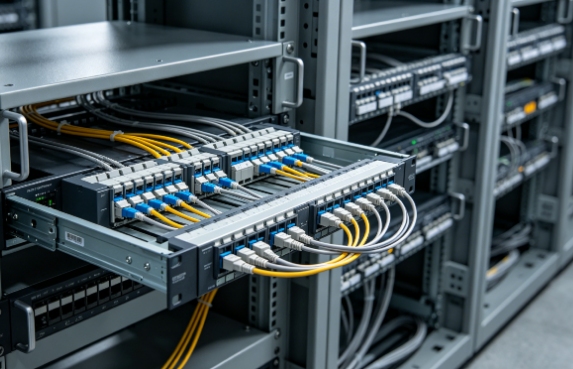
Enabling True Plug-and-Play Connectivity in Fiber Networks
The core function of the 24F MTP trunk cable in plug-and-play systems is to eliminate traditional manual fiber handling and enable fast, standardized connections between network devices.
- It uses factory-terminated MTP/MPO connectors, allowing direct connection to patch panels, modules, and transceivers without on-site splicing
- The standardized interface ensures that all connections follow a consistent structure, reducing configuration complexity during deployment
- Pre-tested fiber assemblies guarantee stable optical performance, minimizing the need for post-installation adjustments
This plug-and-play capability significantly simplifies deployment and makes fiber networks easier to build and scale.
Serving as a High-Density Backbone for Modular Systems
In plug-and-play fiber architectures, backbone cabling plays a crucial role in connecting different network segments. The 24F MTP trunk cable acts as a high-density backbone that supports efficient data transmission across the system.
- It consolidates 24 individual fibers into a single structured cable, reducing physical clutter in backbone pathways
- Its compact design allows more efficient use of space in racks, trays, and distribution frames
- It supports parallel optical transmission, making it suitable for high-speed networks such as 40G, 100G, and beyond
This makes it ideal for modular data center designs where scalability and density are key requirements.
Simplifying Installation in Plug-and-Play Environments
One of the main advantages of plug-and-play systems is reduced installation complexity, and the 24F MTP trunk cable plays a major role in achieving this efficiency.
From a deployment perspective:
- Installation becomes a simple connection process between pre-terminated components, eliminating time-consuming fiber splicing
- Technicians can deploy multiple trunk cables simultaneously across different zones, enabling parallel installation workflows
- Reduced manual fiber handling lowers the risk of errors such as misrouting or incorrect termination
As a result, large-scale fiber systems can be installed faster and with greater consistency.
Improving System Organization and Operational Efficiency
Plug-and-play systems rely heavily on structured cabling, and the 24F MTP trunk cable helps maintain organization and efficiency within dense network environments.
For example:
- Grouped fiber structure simplifies cable identification and reduces confusion during maintenance
- Cleaner rack layouts improve accessibility for upgrades and troubleshooting tasks
- Reduced cable clutter minimizes accidental disconnections and enhances overall system stability
These improvements make long-term network operation more manageable and reliable.
Supporting Scalability and Future Expansion
A key advantage of plug-and-play fiber systems is their ability to scale easily, and the 24F MTP trunk cable provides strong support for this requirement.
- New trunk cables can be added without disrupting existing infrastructure or requiring system redesign
- Modular compatibility allows seamless integration with patch panels and high-density fiber modules
- Infrastructure can be upgraded incrementally to support higher bandwidth demands without full replacement
This flexibility ensures that networks can evolve alongside increasing data requirements.
Conclusion
The 24F MTP trunk cable plays a central role in plug-and-play fiber systems by enabling fast installation, simplifying cabling structure, improving operational efficiency, and supporting scalable network expansion. Its high-density, pre-terminated design makes it an essential component for modern data centers and enterprise networks. As fiber infrastructure continues to evolve toward greater speed and flexibility, this cable provides a reliable foundation for efficient and future-ready plug-and-play network architectures.